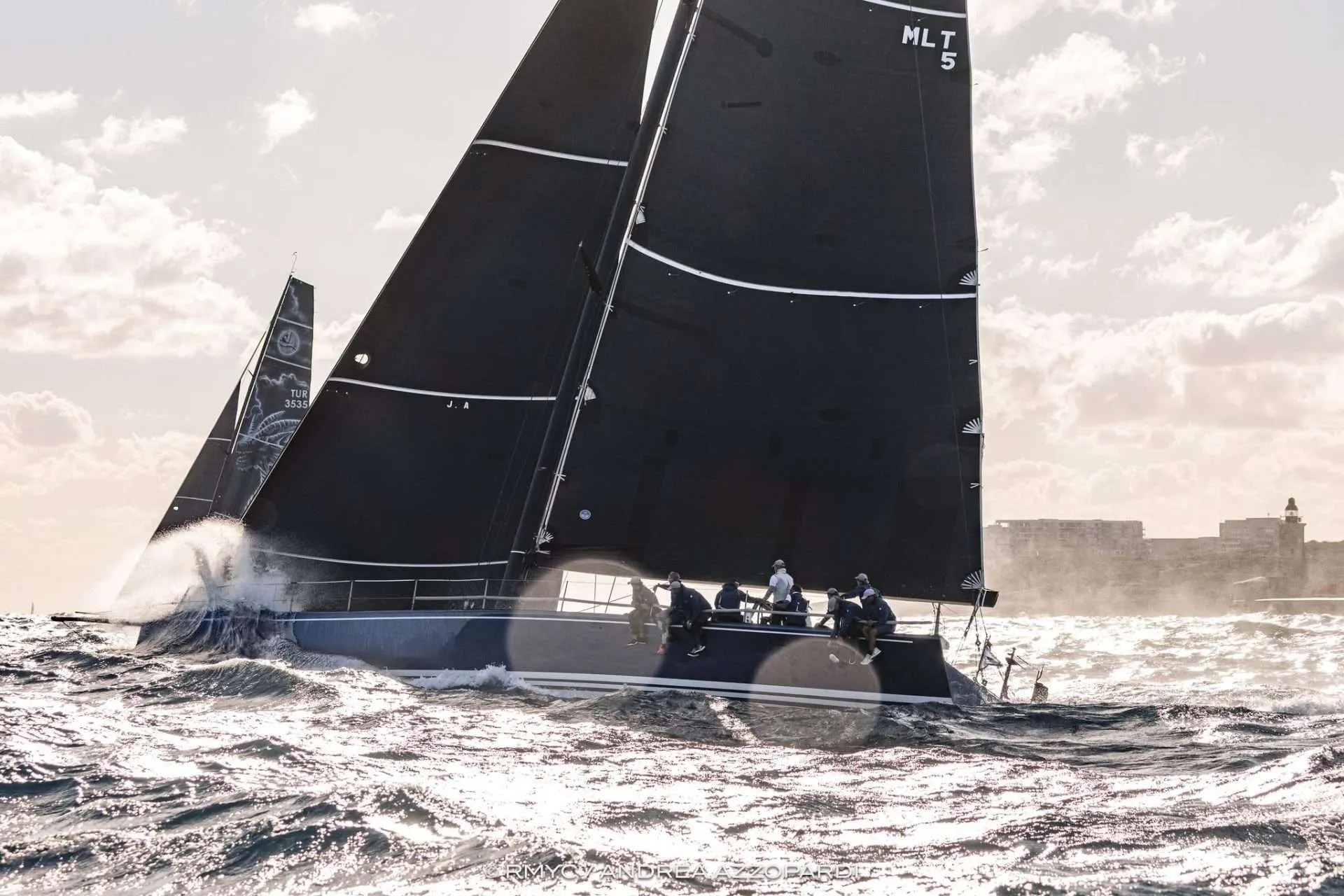
Interesting take from Bouwe Bekking from onboard Pyewacket, the 68′ sled on the just completed Pac Cup….

Screenshot
I’ve had quite a few questions about how the scoring worked for this year’s Pacific Cup, where Pyewacket finished 2nd in class and 4th overall.
First of all, congratulations to all the winners. Every team sailed a solid race, no doubt! That said, I’d like to share some thoughts on the scoring system.
The organizers use weather-model routing (GRIB files) to calculate handicaps. But is that always the best approach? Personally, I don’t think so.
The challenge is that weather models change constantly—especially over a 2,200-mile race where navigating the Pacific High is often the defining factor. The forecast for the final 60–70% of the race is frequently very different from what was predicted at the start. Simply put, weather models aren’t perfect.
On top of that, the @PacificCup has staggered starts. Slower boats begin up to four days before the faster boats, meaning they’re often racing in completely different weather systems. Comparing those performances using a single routing prediction becomes incredibly difficult.
Light-air sailing adds another layer of complexity. As weather expert Chris Bedford often says, weather models don’t represent light-air conditions particularly well. Yet the routing software tends to “thread the needle,” choosing the shortest route through light-air zones because it looks fastest on paper—even when reality often proves otherwise.
Our team began studying the weather ten days before the start, comparing multiple models twice a day and watching the trends develop. By race morning, the handicap generated from the chosen GRIB simply didn’t make sense to us.
Under that rating, we owed Ragtime roughly 2–3 times more time than we would under a fixed wind matrix like the Pac Cup or Transpac TCF published on every ORR certificate.
Their routing model had Pyewacket taking an extremely aggressive northern route that, on paper, would beat Ragtime by more than a day—even though our ORR certificates indicate we’re only about 4% faster in the same wind conditions. That’s because this scoring method doesn’t compare boats using the same wind over the course. In our case, we ended up on the wrong side of that equation.
I’ve raced under weather-model routing several times now. It can work well when the forecast models agree and there’s consistent breeze. But when light-air zones are involved, the uncertainty grows dramatically. At that point, the outcome can feel less like a sailing competition and more like rolling the dice.
I’m curious to hear what others think. Is weather-model routing the future of offshore handicap racing, or should fixed wind matrices still have a place? I know what i prefer