It has been a full month since the 17 competitors in the Golden Globe Race set off on their France to France race around the world. That in itself is a milestone and month that has been full of potholes, some trade winds, a big storm named Gonzalo and a lot of tedious drifting calms; a perfect pot of predictable conditions that included the famous (infamous) pot, the Pot au Noir.
One month into the race four boats have now crossed that invisible line and bumped into the Southern Hemisphere with a half dozen or so within 300 miles. The equator is an important milestone. For a race that is as long as the GGR, it’s important to break it into digestible chunks and the first big chunk is from the start to the equator. Tick that box and you are well on your way.
So far the race has been a bit of a doddle. With the exception of Tropical Storm Gonzalo that whacked the final vestiges of life on land out of the sails of all the boats except the two leaders who were far enough south to remain unscathed, it has been fairly pleasant sailing, well except for the aforementioned Pot au Noir, the French term for the doldrums.
Anyone who has done some extensive offshore sailing will agree that it’s the calms that can deal the biggest blow to a sailors mental state. As Samuel Taylor Coleridge wrote in his 1798 poem The Rime of the Ancient Mariner, “Day after day, day after day, We stuck, nor breath nor motion. As idle as a painted ship upon a painted ocean.” The part that Mr. Coleridge left out, at least as it applies to the doldrums, is the bit about the dark squalls that come out of nowhere, drench the boat in torrential rain and without warning shred sails before returning things to flat calm. In all it’s a nasty bit of ocean and truly a place to test a sailors mettle.
The South Atlantic lies ahead and it too is a minefield of potholes dominated by the South Atlantic High, sometimes referred to as the St Helena High as it likes to sit over the tiny island of St Helena. (My memory of visiting St Helena was getting a Dear John letter from my long time girlfriend who had run off with my best friend), but I digress.
The South Atlantic High rotates counter-clockwise meaning that the sailors need to get on the western side of the high pressure to find favorable winds, but getting there is not easy. Once across the equator the southeast trade winds kick in and that means a bumpy upwind slog for a solid week or more. Just because it can, and for a meaningful kick in the nuts, the high pressure doesn’t just sit there; it moves and we all know that high pressure weather is beach weather and beach weather means no wind. It’s tempting to cut the corner to shave off some miles, but anyone who tries this will do so at their own risk. They may find themselves becalmed for days.
So far, the dominant race leader Damien Guillou on his Rustler 26, Solarem, has played the edge of the High perfectly and with a 400 mile lead over his second place rival Irishman Pat Lawless, he found time to anchor in the lee of Trindade Island to check the rig and do some overall maintenance before heading into the deep south.
Further north American Guy de Boer is back at sea after stopping to get some work done on his hull. The lower aft shroud was damaging the hull structure and Guy knew that he would not make it if he didn’t get it repaired. Luckily for him a team of volunteers descended, epoxy and sharp saws in hand, and the repaired hull is now the strongest point on the boat.
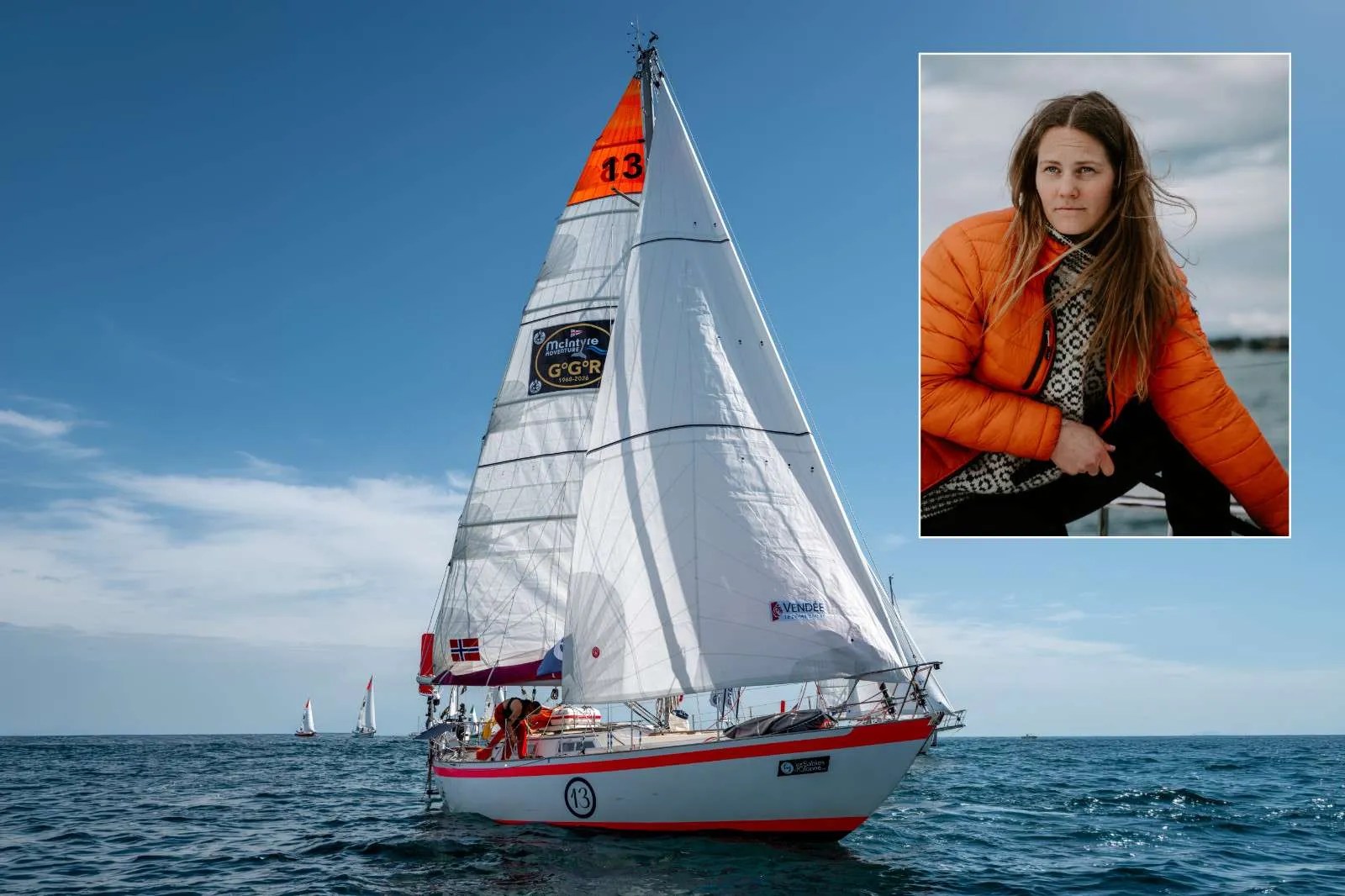
The storm that swept the fleet almost took one casualty, Norwegian sailor Helga Marie Løvenskiold Kveseth
(say that twice fast) who goes by Mara. Per race rules the sailors are not able to get on the Internet, but Mara, anxious to see how her social media was doing, asked a passing ship to take a look for her (also against the rules and she got a warning from the race officials). The upshot was that her social media team had been doing a lousy job (apparently) and without a growing following she wondered if there was any reason to carry one. There will be a piece about this early next week because it’s an interesting quirk in offshore ocean racing that no one could possibly have seen coming.
Mara is still in the race.
The next big chunk for the sailors to bite off will be passing the line of longitude of Cape Town and better yet, passing the line of longitude of Cape Agulhas which marks the line where the Atlantic and Indian Oceans meet. For now it’s one month at a time, one week at a time, one day at a time and one watch at a time. – Brian Hancock