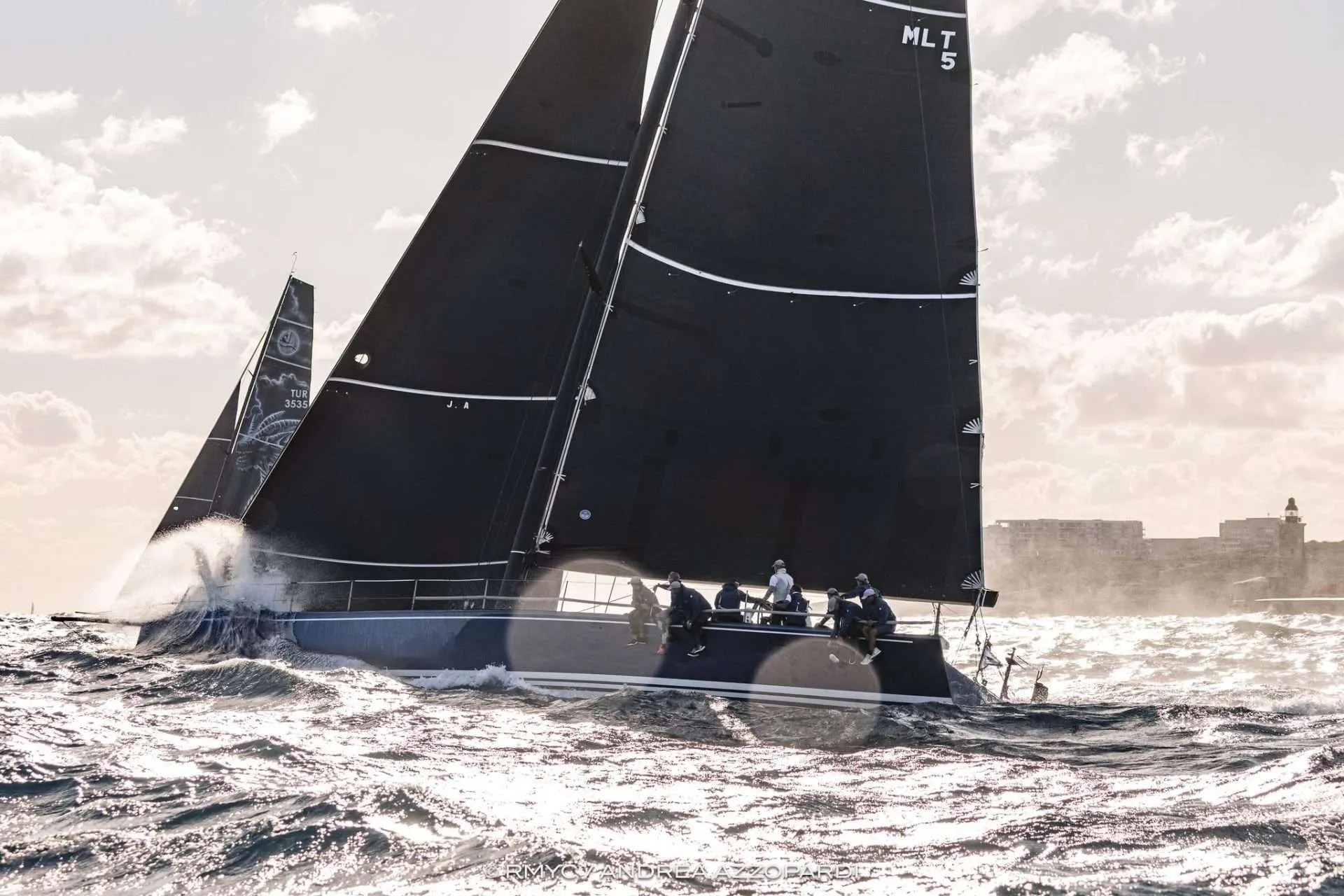
The IMOCA racing scene is heating up with three brand new, latest generation boats having been built and launched in 2026 and two more on the way scheduled for launch in early 2027. The boats that have already been launched are a new Malizia for the German sailor Boris Herrmann, a sistership built for the Frenchman Tomas Ruyant and a new DMG Mori for the Japanese sailor Koji Shiarishi. These three boats have already done some initial sailing and in the case of DMG Mori and Malizia are on their way to New York for the start of The Ocean Race Atlantic. This article will focus on the boats; the next one will be about the upcoming races for the late summer and fall.
I have been going to the start of the Vendee Globe since back when French sailor Christophe Auguin won the race in ‘90/91. I was his sailmaker. The sailing public marveled at his boat, Group Sceta. It had a massive beam designed to get the water ballast as far outboard as possible. There was very little consideration given to any on-deck comfort and safety. A low cuddy provided about as much cover as a kid with a hose blasting you while you hide behind a beer can. Below deck was not much better.
It’s hard to not think that innovation in the IMOCA Class had reached its peak back in ‘91, that they would never be able to design and build a faster boat. Looking at Group Sceta now against these three newly launched boats, the older generation IMOCA’s had about as much pizazz as an O’Day 32. In other words they looked like something that your grandmother could have designed; and sailed, well maybe not sailed.
Before we look at the changes and improvements of the new boats, let’s take a quick look at some details about each of the teams. One thing that stands out is the collaboration between Malazia, TR Racing and Banque Populaire. They jointly went to Finot Conq, the once dominant design firm for IMOCA’s (Finot Conq designed Auguin’s Group Sceta) and had them, along with the brilliant upcoming architect Antoine Koch, lead the design with the three teams all sharing ideas going with the logic that three heads are better than one.
Koji Shiarichi chose what has now become the more conventional and proven choice of naval architect in Guillaume Verdier knowing that he has a solid design team and his designs are well proven.
There are two more IMOCA’s slated for hitting the water soon. The aforementioned Banque Populaire will splash early next year as will TeamWork-Team Snef also designed by Guillaume Verdier. TeamWork-Team Snef will be skippered by Justine Mettraux who came 8th in the last Vendee Globe and was the first woman to finish.
The new IMOCA’s are a definite improvement on the boats that were sparkling new for the last Vendee Globe which seems like it just finished. The designers have focused on a number of important areas. Let’s start with the first one as this one surprised me a little. The 2028 generation of IMOCA’s are placing more emphasis on human comfort and functionality in addition to improving boat speed. In the past it has all been about raw speed, don’t spare the horses on any account and don’t give a sixpence if the sailor running the machine is battered, bruised and exhausted. Turns out that an exhausted sailor can’t do much with all that extra speed when he/she can barely reef the headsail. Previous entries prioritized extreme power over comfort; that goal has shifted a little.
Then there is that pesky light air upwind boat speed. These ‘boats’ are meant to fly, not sail. Once the foils lift them out of the water the whole dynamic changes, however without sufficient breeze to make them airborne they are stuck in the water. In order to help, the waterline has been refined to address the dead-zones common in the older scow-style or extreme-wedge designs. It’s called wetted surface or friction, or if you want to get fancy, the boundary layer which is a microscopic layer of water right against the hull that ‘sticks’ and travels along with the boat due to friction. In other words it slows the boat down so a lot of attention was paid to refining the underwater shape and reducing as much wetted surface as possible.
They also paid attention to fast downwind speeds by adapting a double chine, low profile shape. One thing to understand about these boats is that they will do anything to get rid of water and I am not just talking about flying them. A chine is a hard edge that allows water to separate and no longer cling to the hull. If one chine is a good idea, then why not add two? Any water that is not separated by the first chine meets its match at the second chine.
The other area where getting rid of water is critical is the water that lands on the deck. We were all taught at school that a 5 gallon bucket of water weighs 44 pounds. That seems like a lot of weight for just a few bucketfuls, but think about how many bucketfuls land on the deck each time the boat crashes into a wave. The best thing to do is to get rid of the water as quickly as possible and with that in mind the designers have been working on ways to shed water faster and to keep the deck drier.
Koji on DMG Mori has incorporated a ‘bustle’ that runs the length of the hull on the centerline. The bustle is there to add some buoyancy to the boat which will also reduce wetted surface which in turn will help with light air sailing. More here.
It’s important to remember that microseconds count over a course of 27,000 miles. The Whitbread sailors of old used to cut their toothbrushes in half to save weight. Over the course of 27,000 miles and nine months at sea, every little bit helps.
Let me leave you with a quick bit of Hancock wisdom, and a story (of course). The wisdom is as such. It’s good to get your boat going fast, but remember if you are not going in the right direction you are going fast in the wrong direction (which, by all accounts) is not good.
Second, I have known Boris and Koji for many years and seen their careers as professional sailors take off. Boris was just a relatively unknown 505 sailor when I met him. Koji had done a circumnavigation and wrote a book about it. He gave me a copy and dedicated it. The book was written in Japanese. I was thrilled until one night I brought it out to show friends, and there was no dedication to be found. I could swear that he had signed it. As I was putting the book back in my bookshelf, feeling a little deflated, I suddenly remembered that in Japan they read their books from the back to the front. There, at the back of the book, was Koji’s dedication to me.
Brian Hancock