What do you do when you have won the Vendee Globe (2012/13), the solo, non-stop race around the world, and you have set a new world record for the fastest solo, non-stop circumnavigation (78 days, 2 hours, 16 minutes, and 40 seconds).
Well you go sailing and why not? If your name is François Gabart you can pretty much do what you want. And it appears that he is doing exactly what he wants.
First off, he went sailing. This time it was not aboard some highly strung carbon fiber machine; it was on a modest catamaran and as crew he recruited his life partner and his children. Along the way, this time with some time on his hands, he came up with a darn good idea.
How about a massive catamaran cargo ship that’s powered by the wind, not the pollution generating oily black smoke that comes from a regular diesel engine? And so Vela Transport was born, well at least conceived.
Some history. When I first worked for Hood Sailmakers back in 1980 (a long time ago) we built a massive dacron sail that was going to be hung from a steel mast on a ship to help move the ship along when the wind was in the right direction. The idea was to help save on fuel. The sail had custom aluminium slides and the steel mast had a track. Apparently it worked but they never bought another sail.
Fast forward to 2008 when, a then relatively unknown German sailor, Boris Herrman signed up for a race that I co-founded for Class 40s sailing either solo, or double handed around the world. His sponsor was Beluga Shipping, a German based company that created a niche by using kites, well spinnakers, to help power their ships. They formed a separate company called Sky Sails and fitted their ships with a rudimentary kite that was attached to the ship by a steel cable. Beluga estimates that the kites, depending on the vessel, route, and wind conditions had fuel savings that ranged from roughly 5% up to 10–30%.
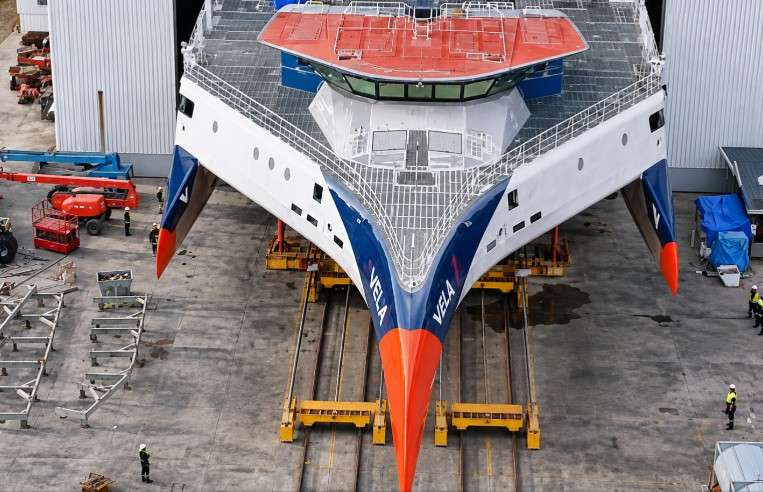
Now comes Gabart. His project, in collaboration with VPLP designers, have built a 67-meter trimaran in the Philippines. The project is behind schedule (what sailing project isn’t?) and in September they rolled out the completed hull and announced, “The Albatross has left its nest.”
The idea is to use the massive multihull to transport cargo across the world’s oceans. It has two carbon masts that are 52 meters high (220-feet for us living in the dark ages called America), and with its carbon sails is expected to sail at an average speed of 14 knots.
Gabart believes that his idea will rival the times and cost set by transporting cargo in a more conventional way, by air, and it will do so in a carbon-footprint neutral way. Let’s just say, simply, I hope that he’s right. I would far rather be passed mid-atlantic by a massive sailboat transporting my latest case of Rémy Martin XO, than a smelly, gas guzzling ship with rust stains and a half-drunk Cuban captain.
I think that the future is here and we are staring at it in the face. – Brian Hancock