The dam has finally burst. At the urging of their Oceanic & Offshore Committee, World Sailing has announced a global survey of the offshore racing community to gauge their views on the impact of technology on the sport.
This long-overdue initiative comes after the Committee’s recent proposal to amend the Manual Power rule (RRS52) to the effect that yachts using automated technologies should be scored separately from those being sailed by conventional human endeavour.
The official announcement by World Sailing says the planned consultation “follows several years of broad discussion within offshore sailing about the implications of developing technology for the sport”. Meanwhile, automated systems were allowed to develop unregulated at an astonishing rate.
Nothing about the issue of employing computer-driven machinery in offshore racing is simple. The WS Committee’s Rule 52 proposal provoked an instant backlash from the Commodores of some of our most prominent offshore racing clubs. But this not a straightforward ‘right v wrong’ situation: there is a complex cross-current of factors in play that challenge the essential principles of what constitutes a fair contest.
World Sailing is the ultimate authority in the sport but the global administration of sailing has always struggled to express itself as a clear democratic process. Whose interests does it really represent? Its own? The various national authorities? The clubs? The classes? The owners? The sailors? Those interests will not always align, and can even be in conflict.
A parallel concern is knowing to what extent WS decisions are informed by a genuine understanding of what the sailors (who will be governed by those decisions) actually think about an issue in the sport. In that context, the decision to now survey the views of the offshore racing community is a welcome development.
It is easy to forget how naïve the Organising Authorities were when first confronted with this problem. In 2020, the Royal Ocean Racing Club released a “Review of Automatic & Wind Vane Devices for Steering in Fully Crewed Racing 2020”. This was their conclusion:
“As yet, there is no empirical data that suggests there are universal advantages with modern automatic steering systems against fully crewed boats. It is therefore the recommendation of the Race Office that automatic steering be adopted for fully crewed racing in RORC events (to also include major events).”
Time has shown that to be wrong, and there were plenty of knowledgeable people who warned against making such a significant error. But, because the RORC is considered to be the ultimate authority on ocean racing, that decision stands. It remains the primary source of the current difficulties in establishing fair racing across diverse fleets. It also shows how foolish it is to make absolute pronouncements in areas that only the experts truly understand.
A year after the RORC ruling, the dominant Australian offshore OA, the Cruising Yacht Club of Australia, attempted to resolve the issue when it established a Special Purpose Working Group. Their report, released in June 2022, concentrated on the fairness of allowing autopilot in the two-handed division while not for fully-crewed boats. Their conclusion:
“The Group consulted widely on the key issues of relative performance and handicapping. Their conclusion was that there is no convincing evidence that autohelm makes any major difference to performance offshore.”
The CYCA did, at least, accept that the two-handers should race as a separate division, “scored within their own handicap category divisions and not be eligible to compete against fully crewed boats for the overall race win”. COVID then forced the cancellation of the next Sydney-Hobart race.
By the time offshore competition resumed – hey presto! – the CYCA had changed its mind. Two-handers using autohelm were now eligible for all divisions. What had changed? Nothing. Political pressure from self-interested owners overpowered principle. But the Working Group had prudently recommended that the whole matter be reviewed in 2024. That review never happened while the autopilot equipment has developed substantially.
The disquiet among many rank-and-file offshore sailors over the use of stored power – to steer, trim sails, control appendages, grind winches or move water ballast – is unabated. They continue to see this as contrary to the spirit of competitive ocean racing and argue that human skill, strength, stamina, experience and tactical ability are what make sailing a sport.
Meanwhile, autohelm systems now do much more than simply use fluxgate compass output to keep a boat on a desired heading.
The same solid-state components manufactured in their millions for our cars and smartphones now guide the autohelm modules. Along with heading, they measure a spread of performance elements including pitch, roll, and acceleration – at the rate of ten times per second. That data is instantly co-ordinated, then overlayed with either manual intervention or AI to meet the desired tactical objectives such as VMG, heel, and wind angle. Look Ma, no hands!
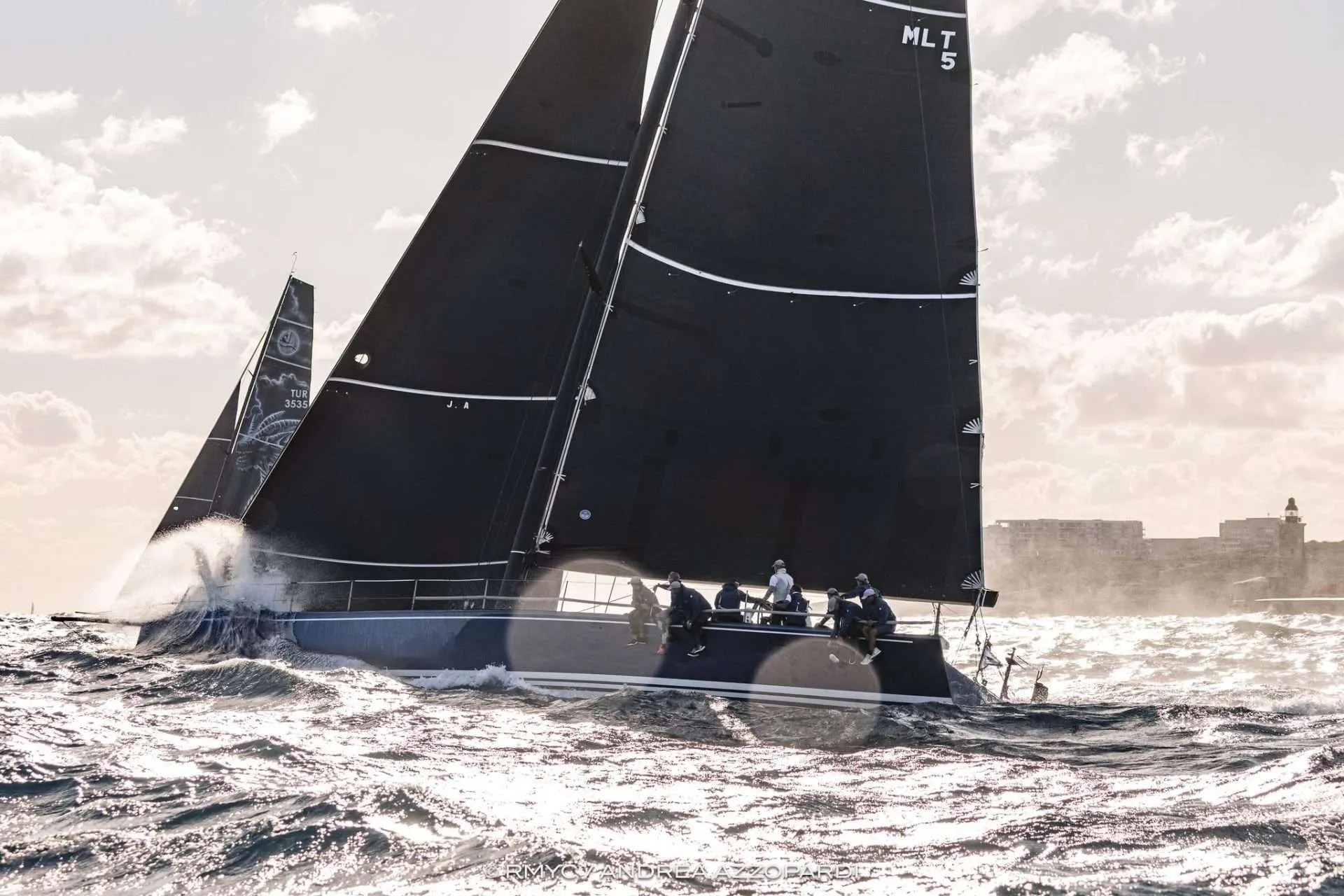
Given this wealth of sensor-derived inputs, it’s no surprise that the Vendée IMOCA boats now sail for up to 99% of their elapsed times on auto. A TP52 recently raced for an 180-mile stretch without a human touching the helm. Even the most experienced members of that crew conceded they could not have steered better, or produced better numbers.
That is the situation now confronting World Sailing. How can runaway technology be somehow constrained so that it preserves the primary human element of the sport? The survey should now provide a useful guide.
In announcing the initiative, Chair of the Oceanic and Offshore Committee, Matt Allen, said: “Technology has always been part of sailing and innovation is an important part of our sport. This survey is an opportunity for sailors, owners, crews, Classes, Rating Systems and Organising Authorities to have their voices heard. We want to understand the views of the people who participate in, invest in and organise offshore racing before determining the best way forward.”
No doubt there is a long way to go before the competing elements of this complicated issue are resolved. Rather than let itself become sidetracked into the usual petty maze of process, the challenge for World Sailing is one of action, not words. They will need to find a sensible, simple-to-implement solution that somehow accommodates both technology and the spirit of human endeavour.
Offshore racing is a sport that grew from the seafaring traditions of “wooden ships and iron men”. That physical quality must be retained. Even the bosses of Formula 1 – the most expensive and technically advanced sporting competition on the planet – still insist on there being a human behind the wheel.

The Bosun