 There is a carnival atmosphere on the docks in St Malo, France as the 115 competitors in the 13th edition of the Route du Rhum prepare to do battle with the North Atlantic. In addition to an incredible fleet of mostly highly strung racing yachts – I say mostly because there are two vintage classes there to notch the average age of the fleet up a little – there is a very large and very boisterous race village.
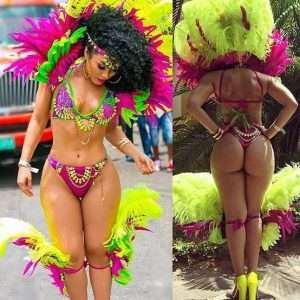
For those who have been to the Superbowl or Soccer World Cup, the Rd uR race village can match things, beer for beer, filterless gauloises cigarette against filterless gauloises cigarette and palpable, pure excitement. The carnival is in town and this is no cruise line. (Oops – did we picture the wrong sort of carnival? Our bad, but enjoy the pic anyway. – ed)
Race officials estimate that well over 1,000,000 people will pass through the village and gawk at the yachts while sipping coffee, enjoying boudoirs which are dipped into said coffee, and sipping a pastis with water while pondering the race program. These are not sailors; these are your average mom and pops that come from all across France to take it in. Walking the docks you may encounter a lady dressed as Mary Antoinette, or a large, muscular man carrying a tiny poodle. It’s all part of the atmosphere.
Ahead of Sunday’s start it’s fun and games (mostly), but once that start gun fires, the sailors will be sailing in the wake of a lot of history and mystery.
1990 marked two firm norms in the race. There was a distinct shift to trimarans and the size limit of 6o-feet was established, indeed two notable skippers, Bruno Peyron and Francis Joyon were excluded from the race because their boats were 65-feet overall. In typical Joyon style, and you have to love the French, he lopped off a section of his hull just days before the start and he and Bruno sailed as “pirates” meaning that they weren’t included in the official rankings, but did the race anyway.
As is typical for November, storms battered the fleet and damage began to occur. Jean Maurel aboard Elf Aquitaine III lost his mast, and the centerboard on Laurent Bourgnon’s yacht exploded, causing a flood of water to enter the hull. It’s always a crash and burn exercise getting out of France, and the ‘90 race was no exception. What was the exception was that for the first time since the race’s inception it was won by a woman.
Florence Arthaud stormed across the finish line in Pointe-à-Pitre in Guadeloupe in spectacular fashion. The silver hull of her yacht reflected the myriad lightbulbs from the press while Florence stood aft of the windward hull, hair flying with an expression that was both utter exhaustion and total exhilaration. It has since become one of the most iconic images of the race. Florence was sadly killed when the helicopter that she was flying in crashed in Argentina in 2015.
The 1994 race brought no less drama. Again those pesky early winter storms wrecked their own kind of hell on the fleet with race favorite Loick Peyron dismasted, and fellow french sailor Halvard Mabire capsizing when the keel of his yacht broke off.
The number of entries were down however the quality of the fleet was up. There were now two distinct classes; the 60-foot trimarans and the 60-foot monohulls, with the monohulls sporting early versions of what would become known as aircraft carriers with their excessive beam there to get water ballast as far outboard as possible. There were 24 entries; 12 multihulls and 12 monohulls. The race was won by Laurent Bourgnon who went on to win the 1998 edition as well becoming the first skipper to win back-to-back races.
The 50-foot monohull division was won by Ellen Macarthur. If you will indulge me for a moment. Ellen had chartered my Open 50 Great Circle for the race, and was on her way to England to ready the boat when Pete Goss’s boat became available. My boat, like all earlier Open boats, did not have an engine. It was powered by an outboard. New race regulations required an engine and with time slipping, and the fact that Pete’s boat already had an engine, Ellen switched yachts (long story of how things transpired after that).
Suffice to say, and I am in a unique (if unwanted) position to speculate that had Ellen not raced Pete Goss’s boat, and had taken mine instead, she might well have had a very different career trajectory. Pete’s boat was fast, mine not so much despite best intentions. It was beautifully designed, built by Concordia Yachts in Massachusetts, was cutting edge in every sense, but I’m afraid, the boat was a dog. Ellen most likely would not have won her division in the RduR and perhaps she would not have been sponsored for the 2000/2001 Vendee Globe where she finished second. Life has its twists and turns; I simply moved on and wrote a book about it all. – Brian Hancock